The Asterisk That Eats Your Budget: What 'Subject to Survey' Really Means on a Window Quote
A window quote lands in your inbox with a nice round number and a line near the bottom: subject to survey. It sounds responsible. Sensible, even. Of course they need to check. But that little phrase is doing more work than most homeowners realise. In some contracts it is a sensible caveat. In others it is the escape hatch that turns a fixed-looking price into a moving target once the fitter has your deposit and your old frames are on the driveway.
The expensive line in a window contract is rarely the survey fee. It is the unknown. The bit nobody measured properly, the lintel nobody checked, the reveal that turns out to be three different depths depending on which corner you inspect. 'Measurements to follow' is not admin. It is a price placeholder, and placeholders have a habit of growing.
A sales visit is a conversation. A survey is a diagnosis.
A sales visit is there to sell you a style, a colour and a monthly figure. A survey is there to find out whether that style will actually fit the hole in your wall. They are different jobs, often done by different people, and they should not be blurred together.
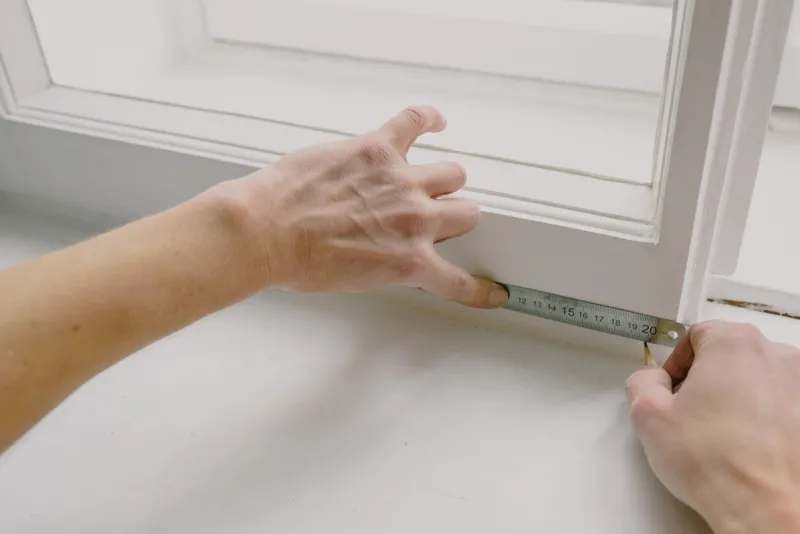
If the person who quoted you spent twenty minutes in your front room with a tape measure and a brochure, that is not a survey. It is an estimate with a logo on it. A proper survey happens before the price is fixed, or at least before you hand over a deposit. It involves checking the opening as it is, not as the brochure hopes it will be.
This is not a criticism of salespeople. It is a question of risk. A sales visit is commercial. A survey is technical. When a quote treats the two as interchangeable, the gap between them becomes your problem.
Where the risk quietly changes hands
There are three risks in every window replacement: the size, the structure and the making good. A good quote is clear about who owns each one.
Size risk is straightforward. If the window arrives too small, someone has to pay for a new one. If it arrives too large, someone has to pay for a fitter to stand around while it is sorted. If you supplied the measurements, that someone is usually you. If the company surveyed, it is usually them.
Structure risk is messier. A crooked opening, a tired lintel, a reveal that is not square, a sill that does not drain properly — these are not visible on a glossy quote. They are found on site, usually after the old window is out. A quote that says 'subject to survey' without explaining what happens when the survey finds something is not really a fixed price. It is a starting point.
Making good risk is the one homeowners forget. Removing old frames damages plaster, tiles and render. Sometimes a little. Sometimes a lot. If the quote does not state what making good is included, the answer is usually 'not as much as you hoped'. That is not a variation you want to discover in week two.
What a proper survey should actually check
A decent survey is not a five-minute tape measure. It should look at the opening from the inside and the outside, and it should check the things that change the price.
- Measurements at multiple points — top, middle and bottom, plus diagonals to check for square.
- Levels and plumb — because a window that is level in the workshop can look drunk in a crooked reveal.
- Reveal depth and shape — deep reveals, splayed reveals and non-standard openings all affect how the frame sits and how it is finished.
- Lintel and structural condition — cracks, sagging, previous alterations and anything that looks like it has been 'got at' over the years.
- Sill and drainage — where water goes, and whether the new frame will sit properly on what is already there.
- Access and working space — scaffolding, restricted access, upstairs windows, conservatory roofs in the way.
- Ventilation and compliance — trickle vents, fire escape requirements and any conservation or planning restrictions.
- Old frame removal and disposal — who takes the old units away, and who pays for the skip.
- Making good and tolerances — what is included, what is not, and how much movement or unevenness the fitter will accept before it becomes a variation.
That list is not exhaustive, but it is a fair test. If your quote was produced without most of it, the phrase 'subject to survey' is doing a lot of heavy lifting.
The variation conversation you want to have early
Survey findings are not automatically a scam. Old houses are old. Sometimes a lintel is shot, a reveal is miles out, or a bay window has been held together by paint and optimism since the 1980s. The issue is not that variations exist. The issue is whether they were foreseeable and whether the quote gave you any warning.
Ask three questions before you pay a deposit. First: what is the process if the survey finds something different? Second: what are your day rates or unit prices for common variations? Third: what tolerance is built into the quoted price before you get charged extra? A company that can answer those clearly is usually a company that has done this before.
Get any variation in writing before work starts. A verbal 'we'll sort it' is not a price. It is a hope.
Homeowner-supplied measurements: the risk you did not insure
Some homeowners measure themselves to save a few quid or to speed things up. That is fine if you understand what you are taking on. If you supply the measurements, you are usually accepting responsibility for them. A fitter cannot make a window bigger on the day. If the opening is out of square and your number was optimistic, the mistake is yours, not theirs.
That does not mean you should never measure. It means you should not measure and then expect the window company to carry the risk for free. If you want them to own the fit, let them survey. If you want to own the measurements, get a written confirmation of what happens if they are wrong.
How to compare 2026 quotes without being fooled by the fixed price
A cheap quote and a complete quote are not the same thing. One may include the survey, making good, disposal and a sensible tolerance for the fact that walls are not laser-cut. The other may leave those out and rely on variations later.
When you compare quotes this year, put them side by side and check for the boring bits: Is the survey included before the price is fixed? Is making good included, and to what standard? Is old frame disposal included? Are scaffolding and access covered? Is VAT included? What exactly does 'subject to survey' allow them to change? Is the deposit refundable if the survey reveals something that changes the price beyond your budget?
If a quote looks unusually cheap, ask what it excludes. If a quote looks unusually vague, ask for a surveyed price rather than an estimated one. The difference between those two numbers is often the difference between a budget and a bank transfer.
A short pre-deposit checklist
Before you sign, make sure you can answer these:
- Has someone surveyed the opening, or has someone just measured it roughly?
- Does the quote state who carries the risk if the measurements are wrong?
- Is 'subject to survey' followed by a clear process, or just left hanging?
- Are making good, disposal and access included in writing?
- Is there a tolerance allowance for uneven walls and reveals?
- Will variations be priced before work starts, not after?
The survey is not the boring bit before the real work. It is where the real price is decided. Treat 'measurements to follow' as a warning, not a formality. A quote built on guesswork is just a number with a letterhead. A quote built on a proper survey is something you can actually budget for.